It has been raining a lot, even in Salasaca. In the late afternoons, the clouds sometimes clear up and you are treated to a couple hours of sun and breathtaking views, and then an even more breathtaking sunset usually follows suit. Not so bad.
With all of the rain, our crop up at the school has really shot up. It is amazing to see what a little water can do, especially compared to our drip irrigation system. (In addition to that, we only get irrigation water in our sector of the community one day a week, on Tuesdays.) Anyhow, the corn seems to have grown literally overnight. This is as green as things get, around here. In the recent photo, (besides the obvious corn), if you look hard enough, you can see: onion, radish, cauliflower, broccoli, lettuce, beans, peas, quinoa, wild spinach, chamomile, carrots, swiss chard, baby stinging nettles, ají pepper, aloe, nopal cactus, and tree tomato.*  Also, just compare the recent photo (at left) with a photo from one year ago (below). It seems like we have grown some stuff, that is for certain.

The apple, avocado, and citrus seedlings (not pictured) have also appreciated the long cold drink of water that the rain has given them. Hopefully someday, they will actually bear some fruit.
In the far right of the (top) picture, you may notice a chicken coop and a small fence (which predictably, is made out of... you guessed it... chicken-wire). This is our new experiment. We have 6 chickens (which have grown even faster than the plants lately). Two of them, someone realized, are roosters, so one will have to be eaten (by us) before they mature completely and start fighting. Darn. The coop itself was built and donated by some lovely volunteers. They (the chickens, not the volunteers) spend most of the day roaming around in their enclosure doing what it is that they do best: peck at stuff that they think might be food and bobble around. Both the coop and the fence are also movable, which is key. We can rotate them around the rows, where they aerate the soil for a period of time and also provide fertilizer for it. Then we plant again. The soil here needs lots of amending, and while our compost helps greatly, the caca de pollo fertilizer does even more so. We could buy it, I suppose, but it is expensive (not to mention stinky to haul around in sacks). Plus, why buy it when we can make it right here for a fraction of the cost? And have fresh eggs, too?
Otherwise, the kids at the school are all preparing for the end-of-the-school-year program, where they get to showcase what they’ve learned in the last year.
Me, well, I am getting ready for that, too. Along with the whole lamb we are going to roast in the pachamanka oven for the day of the program.
*Side bar: Does anyone know what tree tomatoes are, exactly? They are called “tomate de arbol” in Spanish, but I have never seen or heard of them outside of South America. As their name suggests, they grow in rather large (nay, treelike) plants, and are shaped like Roma tomatoes. They don’t seem to be tomatoes at all, though; or at least, they don’t taste anything like tomatoes. Their most common application is in juices.
Wednesday, June 4, 2008
This Salasacan Life

Tuesday, May 27, 2008
Recent happenings, in (not so bullet-like) bullet points
-Have been a bit busy down in these parts. Things at the school are still coming along, as per the usual, and then some. (cf. the forthcoming This Salasacan Life post)
-With respect to the volcano, just this last week, Mama Tungurahua has started to wake up from her little 7 (or so) month nap.  On Sunday, the Geophysics Institute recorded 125 "moderate" explosions, and 32 earthquakes inside the mountain itself. Down in town, I barely noticed a thing. Although, I did recently go up to a lookout point, (where the highway to Riobamba used to be, before the 2005 outburst that she had) and watched a spectacular lava show, complete with an almost full moon and a sky full of stars. It was really beautiful and completely eerie at the same time. At this very moment, there are some rumblings coming from up in her general direction. I´m not sure if this actually happens more late at night, or whether one just notices it more then. Whatever the case, I hope that she just has the volcanic equivalent of indigestion, or something like that.
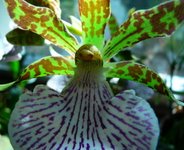
-In less explosive news, and partially due to the rains, I have some purty flowers blooming right now. Yee. Haw. 
-And speaking of, rainy season (winter, here) has begun, along with the occasional landslides and other fun stuffs. I am having a hard time believing that it has been a year already since the last time, yet, the scars on the mountains from last years rains have grown over some (albeit mostly with the fast-growing ground cover). But nonetheless, they once again look like mountains they used to be. We shall see what this year’s rains have in store. There was already a massive series of slides between Rio Verde and Rio Blanco, which filled up one of the tunnels completely. It is amazing that nobody was killed, in fact. If you don’t know this road, (which you likely don’t) there are a series of tunnels that took something like 40 years to complete, which are carved straight through several very, very large mountains. These now obviate the need to take the old road, which was constantly being washed out by landslides and waterfalls and such. I remember taking that old road when going between Tena and Baños, and it could be quite the trick to get the bus around the curves and through the washouts and waterfalls. Usually, the busdriver’s helper had to get out and direct the driver. Sometimes, only 3 wheels of the bus would actually be on the road. I imagine that a good portion of said old road is no longer there. It is a relief to no longer have to take it.
-As for other roads, the one between Baños and Ambato has, on the other hand, been quite good. Since last year’s lahar debacle, the national corps of engineers has been hard at work on a fix for the problem. They started (unintuitively to me, not being an engineer) by building a two-lane bridge where the lahars were the worst, with long cement anchors on each side. From there, they excavated under the bridge, leaving a small canyon for the lahars to run down. This seems to be working, for now. I am knocking on wood that it continues to do so.
-The Sumak Kawsay Yachay Foundation is still coming along as planned, and has been doing a lot, between the Biblioteca Rosa Maria, the Katitawa School, and various other smaller projects. 
-Tula is gone for good. I think that I know where she lives currently, though; with a family that includes a couple of children. I am feeling like it would be worse to steal her (back) from the family that has had her for the last 6 weeks, and in turn break the kids’ little hearts. Maybe she likes it there.
-Also relating to Tula being gone, the neighbors felt bad for me, and so were going to give me one of their puppies. BUT, before they could be weaned, all NINE of them were carried away by the recent floods. No joke.
-More randomly, although it does deserve saying, Langston Hughes never gets tiresome. Ever, ever. 
Tuesday, June 26, 2007
Aaah, Winter
I don´t even know where to start, really. I am (still) back in Baños, where I have been since last Sunday. This is a record-breaking week, in a number of ways. For one, it´s the longest I´ve been in one place in quite a while, as I normally am in Salasaka Wednesday through Sunday, and in Baños the other days. Secondly, the amount of rain we have gotten here has made leaving virtually impossible. People are saying that it hasn´t rained this much in forty years. The flooding is worse to the south, but even still, there are currently 3 obstacles to getting out of town. In order of appearence, they are:  1.) Lahars: These are rivers of mud --sometimes small, sometimes not-- that originate from the volcano and flow down over the road out of town, which also sits (at that point) conveniently right on the edge of a cliff that drops down about oh, 1,500 or so feet to the Pastaza River Gorge. This is also the same area that was most effected by the last eruption in August, and so it is mostly already loose volcanic material from the flow. (There are rooftops of houses that you can see peeking out of the mud-rock-lava stuff along the way.) “Normally”, one can hop a truck up to where the lahars are, and then jump across them, catching a bus or truck on the other side of the roadblock, or walking a ways until one comes by. (This sounds insane, but really, it´s not so big of a deal.) Lately however, with all of the rain, the lahars have not been so small. And, of course, with that much water flowing down the mountain, there are plenty of landslides and large mudflows to go along with the lahars. Fun for the whole family. The national police have the area completely blocked off now. The only people who are getting through are those who are willing to yell at the police and make a run for it, or who have their own cars and are willing to drive throught the barracades while the police scream and threaten arrest. I do not really fit into either of those groups, as it turns out.
 2.) A big chunk of the road (same road, different locale) collapsed. That is to say, the road is now completely gone, for about a 200 ft stretch. Judging from the cracks spanning on either side of the collapse, it also looks as if more of the road will go with the next rainfall, which should begin any second now. The real problem with fixing this is that (again) the now-former road is sheer rock cliff up on one side, and sheer mud cliff down on the other. So, they are actually working right now on removing part of the mountain, so as to make some space for a new road. This is no small task. They say they will be done on Wednesday. Somehow, I sorta doubt it. But, we´ll see.
3.) My favorite obstacle of the three is the overflowing river that suddenly changed its course, and is now in the process of washing out the rest of yet a different part of the same poor road. At the point where it comes down the mountainside and now covers the road, there is also a shrine to the Virgin. Smartly, the shrine was built on a huge rock, and it is the only thing to not have been stripped from that side of the mountain. So, among all of the mud, and uprooted trees, and the (now) fast-flowing water, there is this beautiful little shrine, adorned with flowers and pictures, and painted in bright colors, completely intact. Somehow, it´s not even dirty. Quite an image. No pictures of that, though, as I was a bit concerned at the time that the river would carry the truck I was in over the side of the mountain. Or that the road would collapse.
Sounds kind of dramatic, huh? Well, I can only say that this is what people are having to do here (every day, lately) just to get to work, or to get home, or to take their university entrance exams, or whathaveyou. I did it twice, (once going from, once coming to Baños) as I had planned to go to the doctor in the provincial capital. However, once I got there, I felt fine; no fever, no nothing, and so went shopping for necessities and came back to Baños to get my things to go up to Salasaka. By the time I went to catch a truck out of town again, it was raining and the police weren´t even letting pedestrians through the barracade. I had to turn around and come back home. That´s when you know it´s bad; usually, they will at least let you try to cross the 10 or so “problem” kilometers on foot, at your own risk.
Anyhow, so here I am, in town still. Every morning when I wake up, I look out at the mountains, and there are more and more mudslides up there. One hit the little hospital here on Saturday. And, there are still 2 more months left to the rainy season. 
Local businesses, as you might imagine, are also being hit hard by this weather, since tourists can´t get into town to spend their money. The common refrain around town is “Fuck, if it´s not the volcano, it´s the winter. We are screwed.” Needless to say, there is also a general shortage of things at the moment (gas, fruit, veggies), as the trucks that normally come from Quito and the coast can´t get through to make their deliveries. Also also, the rain this morning damaged the pipes that serve the whole town with water. So, no water, except for at the hotsprings, which are fed by Tungurahua. (This will get resolved quickly, though. Probably even today.*) Luckily, after the last time this happened, I filled up several gallon jugs with water, so I am in good shape this time around. I even had water to make coffee with this morning.
I should say that all of this sounds worse when I write it down than it actually is. Aside from not being able to leave (ok, and not having water today) I personally wouldn´t necessarily even notice that anything was wrong, although town is definitely quieter than usual.
Anyhow, it´s not like I don´t have work to do here, so I have been transcribing and doing other computer stuff that requires the internet (which, knock wood, is still working). Also, my landlord just went down to the jungle (that road was still open, although barely, as of 2 days ago), and she brought me back some endemic orchids. Big ones. In bloom. $.50 a plant. Biodiversity be damned! I want some orchids on my balcony. (I plan to re-plant them on a friend´s property when I leave, don´t worry…)
So, tomorrow is Wednesday, the day that I normally would go back to Salasaka, and that is still my plan. I have tons of stuff to do, and have already been gone for too long. I am antsy. Supposedly, the road is going to be passable tomorrow. Hopefully, it will not rain again. In the event that it does, an indigenous guide friend tells me that there is a cable car across the gorge, that leads to a road out to the provincial capital. Vamos a ver.
*UPDATE: The water issue is fixed!